A to Z Theme 2016

For my 2016 A to Z theme I used a meme that I ran across on the blog of Bridget Straub who first saw it on the blog of Paula Acton. This meme is a natural for me to use on my memoir blog. It's an A to Z concept and it's about me. No research and nothing complicated. I'm given twenty six questions or topics to discuss that are about me.

In April I kept my posts short and uncomplicated. In the midst of it all you might learn a few things about me that you didn't previously know.

Saturday, January 25, 2014

The Cycle of Sickness

Don't Let Sickness Sabotage Your Work - NARA -...

Don't Let Sickness Sabotage Your Work - NARA - 534139 (Photo credit: Wikipedia)

   
       Maybe my body has been conditioned to succumb to illness every year about this time.  It's difficult to get used to, but I've come to expect a bout of illness every January.  Sorry for the pun, but I'm getting sick of it.   The two or three week set back of illness to start the year off is frustrating to say the least and probably a reminder that I'm just getting older so I'd better get used to it.  At least that's what my doctor would have me believe.  And she's probably right.

       Looking back to a post from last January, I see I was writing about the same issue.  I don't want to make a habit of writing about this same topic on an annual basis.  Pretty soon I'm going to have enough material to write a book about being sick.  That sounds depressing enough to me so I hope I can avoid that book.

        I hope you are staying well and able to keep up with life as you would like to be doing.   This year's bout of illness has been hanging on with me much longer that I remember dealing with in previous years.   I've got things to do, places to go, and people I want to see.  I've also got a lot to write about so I need to get my body vigorous and my mind in the right frame of existence.

       At least I've been catching up on sleep, but quite frankly I'm sick of sleeping.  No--let me rephrase that.  I'm sleeping because I'm sick.   I'm sick of being sick and I don't know how else to say it.  Actually I could say it in many ways.  In doing so I could become the Elizabeth Barrett Browning of sickness.  Oh, woe!  Such a sorrowful thought!  Let it never come to that.

       Are you able to write much when you don't feel well physically?    Does your body seem to have developed a cycle of sickness?     Do you ever get tired of sleeping?
Enhanced by Zemanta

Saturday, January 18, 2014

Coping With Unexpected Emotions When Writing Painful Memoirs

        Dealing with difficult past events can stir up painful memories as we relive them in writing a memoir.  My guest today is Lorraine Reguly.  In the following post she discusses her experience in facing the pain that can sometimes be encountered when reviving our past and offers some helpful suggestions to deal with these emotions.

Description unavailable
 (Photo credit: Hayley Bouchard)
      Memoir writing is not all it’s cracked up to be. Writing about enjoyable moments is definitely fun and easy, but writing about painful memoirs and past experiences is very hard to do. I know. I’m currently doing it, and I’m having a tough time.

       Maybe you can relate, if you’ve reached a standstill in your writing or have set your memoirs aside . . . and left them there.

 Today I’m here to tell you a bit of my story and to help you learn how to deal with any pain you may be experiencing. 

       The reason I’m having such a hard time is not due to a lack of planning, but to the unexpected emotional turbulence that comes with writing about painful experiences.

        You see, I was raped when I was a virgin. I was fourteen, then. It devastated me, and my life took off in a different direction. I ended up quitting high school four times. I also had a baby when I was a teenager, and became a single mom. My son is now 23; I’m 42.

       Although I graduated from university and became a high school Math and English teacher, I partook in several other activities that were detrimental to my emotional health. I became a prostitute after being promiscuous for years. I did drugs, gambled, stole, and tried killing myself. Yes, I was a mess.

       I’ve been physically and mentally abused, and have abused myself.

       In short, I’ve been through hell.

       Judge me if you will; I don’t care. But know this: I am not a bad person.

       In fact, I have many wonderful qualities and am highly skilled.

       I’ve also had several health issues and was in an accident that nearly cost me my right leg.

       Last year, I nearly died when my appendix burst. This event served as the wake-up call I needed, and the ensuing events have changed my life in a positive, dramatic way.

       I re-connected with my son. Without going into too much detail here, I’ll simply invite you to read How Re-Uniting With My Son Impacted My Life. It’s quite the story!

      When I started my memoirs, I was hyped up and had lofty goals. My original plan was to write a bit each day. This plan didn’t work for me and so I revised it, deciding to write each week. Then that plan didn’t work, either, because when I started writing, I wrote about the negative stuff that’s happened to me and didn’t balance it with the positive.

     I ended up re-living certain things in my mind and bringing my past baggage to the surface; baggage I thought I had already dealt with. As it turns out, closure is a myth. For me, anyway.

      I also tried writing when I was inspired to do so. This worked well for a while but then I stopped getting inspired. It became easier to write about other things, or not write at all. Writing blog posts became my priority because they were less painful to handle. Coping was not an issue when I wrote about non-personal things. But I stopped reaching my readers – they wanted to hear my true stories!

      My blog theme emerged: True Tales Tuesdays and Featured Fridays. On Tuesdays, I satisfy my loyal readers (who I now consider my friends!) and on Fridays, I satisfy myself, other writers and authors, and hundreds of other people with my various topics including guest posts, author interviews, book giveaways, social media articles, and blogging tips. My blog has become more popular as a result. But it is still very little. I actually like the intimacy it offers; it is now my safe haven.

      In October, I told myself I would work more diligently toward my writing goals in November, and I did – to a point. But then I ended up accepting a blogging award in which I outed my rapist. This was the hardest thing I have had to write – ever. I had previously touched upon this topic when I wrote my blog post about Writing Is Therapeutic and Helped Me Cope With Being Raped but I was not prepared for the tumultuous uproar of panic, hatred and confusion I experienced when I found out my rapist was online. (Side note – I have only owned a laptop since January of this year.)

      Since I, like many bloggers, schedule my posts, I had a couple of weeks to wait until it was published before I finally felt emotionally better. The support that I received from my regular group of readers was amazing and helped me in more ways than I ever thought possible.

       I was not judged; I was loved. I was not hated; I was congratulated. I was not ridiculed or belittled; I was made to feel ten feet tall.

      You may think me brave for speaking out so bluntly. Yes, I was scared. I was terrified, in fact. Actually, I still am, sometimes. But what I have learned is this: I have to follow my heart. If it feels right, I do it. So should you. Write it, whatever it is that you’re holding back. Shout it from the rooftops. Make your voice heard. You won’t regret it, even if is painful and makes you cry.

      Trust me; I know. I’ve been there.

      I’m still there, but now I have a plan in place that will help me achieve my goals.

     No one said writing was easy. Writing painful memoirs is even tougher, which brings me to the tips I have for you, for when you are struggling.

HOW TO COPE WITH YOUR UNEXPECTED EMOTIONS

 Get a support system in place. Find people you can talk to, who will support and encourage you.

 Cry. Cry. Then cry some more. It’s good for the soul.

 Allow yourself some self-pity. You’ve been through a lot. Don’t expect to be “over it” immediately. Accept that your past is a part of who you are. Don’t fight it; embrace it.

 Recognize that only you can tell your story from your point of view. No one else can. No one else has had your unique experience. No one else is YOU. You have a lot to offer even though you may not realize it.

 Love and nurture your inner child. He/she dwells within all of us and if he/she didn’t get what he/she needed as a child/teen/young adult, then give it to him/her NOW. Let your past self connect with your present self.

 Don’t isolate yourself. If you live alone, go out for a walk. Go to the mall. Take yourself out for dinner. Take in a movie. Go be around people, even if you prefer being alone.

 Get out of the house and socialize. Phone a friend. Go for coffee. For crying out loud, do something!

 Identify your emotional triggers. Write down your feelings on a piece of paper and why you think you are experiencing them.

Journal. Yes, this is more writing, but it will help you down the road. You’ll be able to look at things from a different perspective days, weeks, months and even years later. Journal-keeping is often therapeutic.

Take a day or two off. Allow yourself some space to heal. Healing takes time. You may never heal completely, and your scars will always be with you, but you can stop the bleeding.

Commiserate with me. I don’t judge and I’m always happy to meet new people, share experiences, and make new friends.

Above all else, don’t stop writing. You’ll hate yourself for it, if that’s one of your goals. For an extra boost, read Why You Should Take a Chance on Your Memoir Project and Don’t Avoid Painful Writing! If you are simply having trouble sticking to your writing goals, you may find this article helpful: Overcome Writing Failure With a Personalized Writing Plan. Did anything in this post make you have an “aha” moment? What tips make the most sense to you? Do you have tips you’d like to add? I’m anxious to hear your thoughts in the comment section, and I promise I will reply to every one…so please don’t be shy…please say “hi” to me and share your thoughts!


About the author:
picture017 (3)  Lorraine Reguly is writer, teacher, editor, poet and blogger who loves connecting with others as much as she loves writing. Join her each week on her blog, Lorraine Reguly's Life, for her True Tales Tuesdays and Featured Fridays posts.


-- 
Enhanced by Zemanta

Saturday, January 4, 2014

Fly By Town

Harpers Ferry
Harpers Ferry (Photo credit: cliff1066™)
     
       I won't say that I was lost.  I didn't know exactly where I was, but I basically knew where I was going.  I had taken a wrong turn and didn't particularly want to stop to consult the map.  The road I was on would eventually come to a main road that I recognized.  I was pretty sure of that.   Most roads go somewhere and that somewhere will usually provide more options.    You can never get really lost forever on highways.  For a short while maybe, but not forever.

         Winding through mountains in West Virginia, then Virginia, then back and forth again, I was enjoying the beauty of the place yet I was anxious to get back to the main highway.  We had a ways to go and I wanted to get to our motel in Lexington, Virginia before it got dark.

         As we came out of a particularly curvy mountainous area, we emerged into a small community.  I wouldn't quite call it a town because I didn't see anything besides houses.  There were quite a number of these houses.  Houses that struck me as being somewhat large looking two story houses, similar in design and relatively old.  Houses built before 1950--maybe even pre-war.  The community looked neat, but poor.  And odd.  

        The place was eerie odd like something seen in a dream.  In retrospect I almost wished I had stopped, or at least paid more attention.   At the time I was more concerned about finding a main highway and I did after passing the eerie odd community.

         For the rest of the drive that day my mind kept going back to the place on the road that I had flown by.  I felt haunted.  That evening in the motel I looked on my computer to find out where it was that we had passed through.  Nothing.   I could not figure out what that place had been.

        Several weeks later after more careful researching with the help of Google Maps and Google Search, I figured out what place we had flown by.   Bishop, Virginia and Bishop, West Virginia was the town.  A place divided due to having been  built on the border of two states.

          Bishop is an old coal mining town--something I had surmised as we drove past.  I mentioned that to my wife and now it was confirmed for me.  Now with mines closed, Bishop is just part of the Appalachian poverty region.   What was a fly by town to me is a place where a goodly number of people live and struggle to get by.

          Why write about Bishop today?   Because today, January 4th, a Saturday, I hope to pass through there again if my schedule allows.  If I do return, this time I will slow down a bit.  Maybe take some pictures.  Maybe just stop and look for a moment.   The place still haunts me.  If I make sure that it is real--real to me at least--then maybe its ghost will live in my memory a different way.  Not a dream, but a real place.

          Have you ever passed through a town that haunted you?   What is the strangest place you've ever been to?   Are you familiar with Bishop or the Appalachian region of West Virginia and Virginia?

Enhanced by Zemanta

Saturday, December 28, 2013

The Sense of Remembering

senses
senses (Photo credit: joaoloureiro)

       If you're gathering with family during the holidays or even if you're just out and about where the celebration of the season is evident, your senses may be in heightened arousal mode as you are assaulted with the sounds, smells, sights, and other stimulants that cry out "Christmas!".

       This is a time when our senses might be tapping into our past.  Wherever you may be during this holiday time it's good to stay on special sensory alert.   Make connections with your memory as the senses are bombarded.  Hopefully the memories are happy ones, though undoubtedly some may be wistful or even sad.  Take them in.   They're all part of the story of life.

Enhanced by Zemanta

Saturday, December 21, 2013

Christmas: A Time for Memoir Research

Family Christmas Eve 1958
Family Christmas Eve 1958 (Photo credit: catchesthelight)

       The Christmas holiday season is here which means it's a good time to do research for that memoir you've been thinking about writing.  I'm not talking about libraries or hunkering over the computer--though if you have vacation time that needs filling, this type of research can also be a good thing.   The kind of research that suits this season best is time with family and friends, talking, sharing, and remembering.    This is some of the best memoir research we can do--and usually the most fun.

      Like many of us, you'll probably be spending time with loved ones who have played a role in your life.  Especially if you're with parents, siblings, and other family members, you can share memories and ask them to fill in the blanks.  Listen for new stories and information.

      Here are some tips:


  • Conduct interviews--Try to capture it on video if you can.  For those who aren't hams or comfortable with being on camera get them used to talking on camera before delving into the serious topics.
  • Take pictures -- Not just of people and events, but of things around the house that evoke memories.
  • Break out the photo albums-- This doesn't have to be boring.  It's fun to peruse the old albums to talk about old times and people from the past.
  • Make a game out of remembering-- Start an outline or timeline and get everyone to fill in what they remember.
  • Take a drive--Visit places from your past or places with stories behind them.
  • Have a family video chat--Everyone gather around the computer and have a video visit with another relative who can't be with you.  
  • Get plenty of one on one time--The group gatherings are great fun, but richer detail with less inhibition can be garnered with individual conversations.
  • Let the kids get involved--Sometimes younger people don't care what older folks did in their day, but if they show interest tell them what they want to hear about and let them ask questions.  They may provide a different way of looking at things.
  • Write it down!--Have a journal or notebook handy for recording thoughts, quotes, and observations.  In quiet times alone write down what you've done, what people have said, and your reflections about your visits.
        Whether you're writing you memoir or just in case one day you might, if you do the things I've listed here, you'll have a good resource for remembering.  What you do in this time might be something you won't have an opportunity to do later.  Take some time to remember and record those memories for posterity.

          Will you be visiting with relatives and close family during the holidays?   Do you have any genealogy buffs or family historians among your relatives?    What are some ideas that you would suggest for doing memoir research during the holidays?


Enhanced by Zemanta

Saturday, December 14, 2013

Partnering in Memoir Writing: The experience of artist Mimi Boothby

       Memoir often addresses times of pain and struggle. Writing about difficult times of life can bring back memories that cause us to relive the stress and pain, but it can also be a cathartic experience.   Readers of this type of memoir are given a window into a life that includes the good and the bad.  Memoirs of this sort should be instructional as well as uplifting.

        Mimi Boothby has written about the life that she shared with her late husband.  Before his passing he contributed his side of the story which offered a unique perspective to the relationship.  I'll let my guest, Mimi Boothby tell you about their experience:


"Arboretum" by Mim Boothby


I can remember when my sons were in high school, one of them told me that he was the only one of his friends who had a sit down dinner with his whole family almost every night of the week. It was about that time that we realized that had something special. It honestly surprised me, because we had been through so much already, we had had a really rocky marriage.

When I married my husband in 1978, if my parents had actually been present, they probably would have strongly advised against our tying the knot. As it turned out, 3 months after we started dating, we got married and neither of my parents were present for the ceremony. His parents came, and honestly, if I had known them prior to that day, I am not sure that I would have married him!

We were married for almost 35 years, and after a really chaotic first ten years, our relationship started to get better. We learned how to live together and work together. After the kids left home, we started focusing on each other, and by and by, we noticed that we had become a role model for other couples. We really did have something special. We used to talk about maybe we ought to write a book on relationships. My husband, who was in a twelve step program, and sponsored many men through recovery, gave them a lot of advice about relationships. Of course his advice was based on what we had done ourselves. At this point, he wrote "Advice from Donald on Relationships." I loved it and saved it carefully (it is in our book).

In 2011, my husband was diagnosed with a really nasty form of cancer. Suddenly, those dreams we had of growing old together vaporized like so many soap bubbles. And we lived each day together with even more realization of how precious each one was.

One day while my husband was in the hospital fighting for his life, we decided that we needed to write this book. I wrote the first chapter and showed it to him. He loved it and wrote the second, it was his response what I wrote. We did it in a "he says she says" format. Armed with his laptop, he composed and printed out rough drafts for my sons to proof read. Starting from our youth, and finishing with our mature relationship the book quickly fleshed out, we added photos and put it in a blog format just to keep it safe. As his fight for life got more intense, the book was put aside. After he died I forgot the book for a while, caught up in grief. But then one sunny day I remembered, and finished my part of it.

What we wrote is a testimony to our love, an autobiography and memoir of our marriage. I believe that someone reading it can learn from it and maybe improve their own relationships. I changed almost nothing that he wrote, because I wanted to preserve his style. I used Lulu as my publisher and even got an ISBN number. If I wanted to jump through a certain number of hoops, I could sell it on Amazon, but I have not done that yet. I know this book will never make the best seller list, but my children and close friends have this memento, a little piece of history. I know that if I ever have grandchildren, this will be required reading, because it will be a way to acquaint them with the wonderful grandfather they never met. All in all, it was a good experience and I recommend it.

The Other Side of LoveLinks to Mimi Boothby's work:

Our book - The other side of love

my blog Mimi Torchia Boothby Watercolors (Be sure to see Mimi's wonderful artwork)

Donald's Blog The Boothby Chronicles


Enhanced by Zemanta

Saturday, December 7, 2013

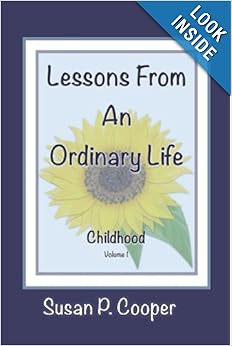
Lessons From An Ordinary Life

        I've been enjoying Susan Cooper's blog for quite some time now.  Since she usually deals with matters of life stories, I thought she'd be a good guest on Wrote By Rote.   In the post that follows, Susan talks about some of the challenges she has faced in her life and the lessons she has learned from them.  She also has a book that you might enjoy reading or buying as a Christmas gift for someone on your list.  I'm happy to present Susan P. Cooper. 


“Lessons From An Ordinary Life”: A Dyslexic’s Miracle

In many ways my new book “Lessons From An Ordinary Life" is a miracle to me.  Why do I think that?

I’ve been asked on more occasions than I can count, why in the world would I choose to write anything, much less produce a book, knowing I’m dyslexic?  That is an excellent question.


So what is this thing called Dyslexia (DRD)?  Please bear with me as I explain.

"It is a general term for disorders that involve difficulty in learning to read or interpret words, letters, and other symbols, but does not affect general intelligence.  It shows up in reading, writing and speech. It is a reading disability that occurs when the brain does not properly recognize and process certain symbols.

Dyslexia or DRD occurs when there is a problem in areas of the brain that help interpret language. It is not caused by vision problems. The disorder is a specific information-processing problem that does not interfere with one's ability to think or to understand complex ideas. Most people with DRD have normal intelligence, and many have above-average intelligence and it runs in families.”

As a young child, I was active and imaginative with large coke bottle bottom glasses that struggled at school. I was unaware of my disability at the time. When struggling with an unknown problem as a young child, it results in developing coping mechanisms.

I was terribly shy around my peers and teachers, not willing to speak, often because my speech would get all twisted up and make me appear "stupid or silly".  Regardless, I was determined not to let my issues prevent me from achieving any desired success.

To cope with my dyslexia, I became an acute observer of all that was going on around me.  Though my observations, I was able to grow into an auditory storyteller.  It was a skill I honed and used for the sole purpose of helping someone see a circumstance in a different light or to teach a lesson.

The thought, or glimmer of an idea for my first book, started many years ago. I often would share a story as an allegory to help someone with a current challenge. Many of my friends and colleagues suggested that I put my stories/allegories in written form or maybe even publish them in a collection. My first thought was doing so was impossible given my disability.

As time passed, the suggestion to publish my stories with my illustrations grew more persistent.  I knew if I genuinely wanted my voice to be heard I needed to find a way to communicate what I had to share.  Be it through what I would write, the drawings I created or my photography. Despite the fact that, it was and is a challenge for me to write well, I knew if I put my mind to it and with the help of all the available tools I have amassed, it could be done.

So here, with the help of an editor, I now have my first solo-published book.  It is my miracle.  My new book is a compilation of some of the short stories/allegories I would share with others. The greatest surprise for me is other books are in the works.

I never dreamed of being a writer or publishing anything. What I did dream about was helping others by teaching everyday lessons in a unique way.

What I’ve learned from this is one never knows where something will take us. Never limit what we can achieve because of our own prejudices about what we can or cannot do.  For me, it was to share a story in the hope that it would help another in some small way.

So, in a way I never expected, I am achieving my dream through my book "Lessons Form An Ordinary Life" now available on Amazon. I would love it if you would take a look.

In closing, if you have a dream, then go for it.  You just never know where it will take you.


Susan is a former Marketing & Sales Executive, now the Publisher and Executive Director for Finding Our Way Now LLC.  
Susan is by nature a storyteller & teacher who makes her home in Northern California with her husband, her greatest cheerleader, and her cat Samuel who watches over everything she does.
Susan’s work now allows her the opportunity to share the many stories she used to teach and the lessons she's learned in life and in the workplace. It has rekindled her passion for drawing, which she now uses to illustrate her stories and podcasts.

What makes this all the more interesting is she dyslexic. So the act of writing for Susan is a serious challenge. It often takes her four times longer to create a story then it does for others without this disability. She will tell you she has never been one to shy away from a challenge and works hard to overcome her dyslectic eye to deliver a quality & entertaining product. As a testament to her efforts, she is now a published author with more books on the way.


For more, check out her new book, “Lessons From An Ordinary Life" and her blog, Finding Our Way Now

The Book:


Finding our way through life involves an equal share of joy and woe. The stories we often tell each other throughout the journey help us make sense of it all. The childhood memories collected here act as self-discovery guideposts for author and reader alike. The deceptively simple lessons shed light on the power stories have to shape and connect us. This collection and the accompanying artwork are a must for those who seek comfort in wondering about life’s seemingly random treasure box of experiences.

Find the book on Amazon


What obstacles have you had to overcome in your life?   Have written a memoir about this or have you considered doing so?    Do you have any questions for Susan about dyslexia or her book?  

Enhanced by Zemanta